

Can you use personal tracking and fitness data records to help your accidental injury case?

You can use personal tracking and fitness data records to help your case. Sometimes in ways that most people would not suspect. Herndon bike and car crash lawyer Doug Landau has used Garmin GPS location data to show where a client was struck by a a dangerous driver. Proving liability in cases where there is no surveillance or intersection video or eye witnesses used to be almost impossible before the onset of activity measuring devices like the: Apple watch, the Garmin line of products, the Whoop, Clio, Oura Ring, Suunto, Samsung Galaxy watch, Casio G-Shock move, and the Zwift monitors. Lawyer Landau has also used health and fitness tracking devices to support his claims of damages, losses, product failure and property damage.
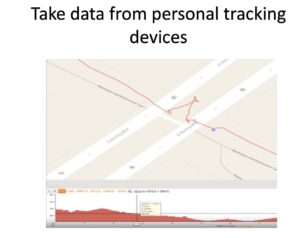
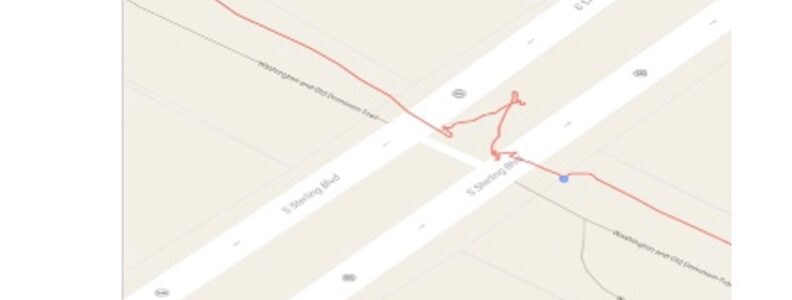
Examples of crashes where this technology has been helpful includes a case where Landau’s client was struck while biking on the W&OD Trail. The cyclist was crossing the street in Sterling, Virginia, when he was “waived through” by the motorist immediately to his left in the first lane, closest to the right side and shoulder of the road. The biker also saw the driver in the second lane of travel waive him to proceed across the road in the pedestrian cross walk. However, what the bicycle rider did not see was a third vehicle, passing the others on the left, traveling in a running lane that was just forming at the W&OD Trail crossing point. After the rider was struck as he nearly reached the center median, the driver and her passenger told the police that the biker suddenly darted in front of them. No charges were issued against the car’s operator, and with no eye witness cyclists to support the injured athlete’s version of what happened, and no other motorists waiting around for the authorities, the injured victim’s chances of success seemed slim to none.
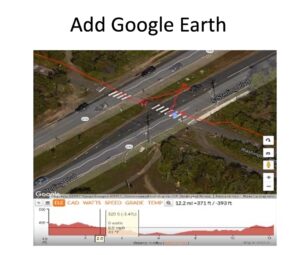
When the injured biker came to ABRAMS LANDAU for help, one of the first things that had to be done was to download the Garmin data from his bike. In addition to his bicycle computer, this cyclist also had a different model on his arm. So lawyer Landau had a “Second Opinion!” The downloaded data showed that the biker was telling the truth. He HAD stopped for over 10 seconds at the crosswalk. He HAD crossed the two full lanes without incident. He WAS struck in the partial forming lane just before his front wheel had hit the grassy median. When Landau questioned the driver, she said she was going to the Manassas Mall. However, this shopping center is SOUTH of where they were heading North. In fact, she and her passenger were lost! Plus, knowing the cyclist’s weight, the mass of his bike, and where he and the bike were both thrown, the speed of the car could be calculated. Based upon these figures, evidence suggested that the driver was not only lost, but traveling in excess of the posted speed limit of 35 MPH! With this evidence in hand, instead of an insurance company “no pay case,” Landau was able to achieve a significant settlement for his injured biker client.
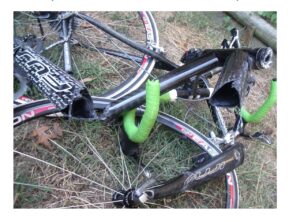
In another case, Landau’s triathlete client was training in Culpeper County on new, high end carbon wheels. Suddenly, and without any warning, the bike crashed on a smooth, flat stretch of road, with the front wheel crumbling beneath the rider. This accomplished age group Multisport athlete, who has won a number of races outright, sustained a traumatic brain injury in the crash. When a claim was brought to the attention of the wheel manufacturer, they denied the claim, claiming that there was “product misuse;” the rider hit a pot hole at high speed; the biker had not been riding safely; the triathlete had put many hundreds of miles on the wheels; and the product was exposed to extremes of heat and cold.
Using the client’s Garmin training data, Landau was able to go to the scene of the crash, where there were no potholes or other road defects. The mileage on the wheels was just over one hundred miles, so that they were almost new. The speeds and routes take prior to the crash were not unusual or unexpected. There was no exposure to extreme temperatures. And, the speed at the time of crash was no more than 25 mph, not a velocity that would exceed the wheels capacity. Confronted with this data, the wheel manufacturer admitted that perhaps this product was from a bad batch and paid the claim.
In order to be successful at winning these personal data and fitness tracking cases, it is imperative to retain experienced legal counsel who understand the rules of evidence and are adroit at explaining the data to an insurance adjuster, judge
or juror who may have no familiarity with this technology. Just because you have the devices, you have downloaded the data, and you have printed out the graphics, it does not mean that this evidence will be allowed in court. Getting the evidence before the judge and jury in court requires proof of authenticity, reliability and following the rules of evidence of the jurisdiction where the case is being heard. The injury team at ABRAMS LANDAU has used personal tracking and fitness data to prevail in their clients’ cases, even where there were no eye witnesses and the insurance companies had denied the claims.

If you, or someone you care about, has been injured through no fault of their own, and they were wearing or using a physical fitness or personal activity tracking device, and there are questions about the laws that apply, how this evidence is used and what kinds of things can be proven, please call us at once. In some cases, especially when athletes are running or riding in a group, the personal black box evidence of others in the peloton can be used to prove aspects of the crash or other harm producing event, like a dog attack or product failure. There are legal deadlines in permanent injury cases and evidence degrades, gets lost or is erased if too much time goes by. We are currently investigating several cases with fitness tracking and GPS evidence where the injured victim and the driver are diametrically opposed.