

Not Clocked in But Still Covered: Workers Comp Benefits for Injured Flight Attendant
In a March 2025 decision, the Virginia Workers’ Compensation Commission reaffirmed an important principle that an employee does not have to be clocked in, or even inside the workplace, to be covered under the Workers’ Compensation Act. In this case, the Full Commission reversed a Deputy Commissioner’s denial of benefits and held that a flight attendant’s pre-shift injury was compensable. While the ABRAMS LANDAU workplace injury team is currently representing several airline flight attendants with shoulder and neck injuries from onboard accidents during their hectic shifts helping passengers during long haul flights, the Herndon law firm has also won and settled major cases for airline employees who are injured on the ground and even traveling on and off the airport properties. “Flight attendants are more than just glorified airborne waiters and waitresses,” notes experienced Herndon Virginia workers comp lawyer Doug Landau, “they have important safety training and perform important duties above and beyond making sure airline passengers get their drinks, pretzels and headphones.”
In this parking lot injury case, the workers comp claimant worked as a flight attendant. On the day of her injury, she:
- Parked in a restricted-access, employee-only parking lot where she was required to park
- Began walking toward the employer-provided shuttle that transported employees to the airport terminal
- Was wearing black block-heeled shoes that were part of her required uniform
- Was pulling a suitcase and carrying a purse
As she approached the shuttle stop, she walked across a ramp containing yellow tactile pavement, a surface with regularly spaced raised bumps. Her heel caught on one of the bumps, causing her to fall forward onto her knees. She sustained what appeared to be a fractured kneecap. The employer denied the claim.
The Deputy Commissioner ruled that the injury was neither:
- “In the course of” employment, nor
- “Arising out of” employment
Relying on the “coming and going” rule, he concluded:
- The location of the fall was not part of the employer’s extended premises.
- The tactile pavement did not create a work-related risk.
- The claimant failed to prove tripping on the surface was an “actual risk” of her employment.
Thus, the claim was denied.
However on review, the Full Commission unanimously reversed.
1. The Injury Occurred “In the Course of” Employment
The Commission focused on the employer’s control and requirements:
- The claimant parked where she was required to park.
- She was walking to the employer-provided shuttle.
- The ramp was the essential means of ingress and egress from the lot to the shuttle.
The Commission held that the ramp and parking area constituted the employer’s extended premises. Because the claimant was using a required access route to reach work, her injury occurred in the course of employment.
Importantly, the Commission rejected the notion that being “clocked in” is necessary. Workers’ compensation coverage does not begin and end at the time clock when the employee is navigating employer-controlled property as part of the workday process.
2. The Injury “Arose Out of” Employment
The Commission also found that the injury arose out of the employment.
While the tactile pavement was not defective, the Commission emphasized:
- The claimant was wearing required uniform shoes with raised heels.
- The ramp had a slight grade.
- The raised bumps created a tripping hazard for someone wearing that footwear.
The Commission concluded that the surface, in combination with the mandated footwear, created a work-related risk. Even if tactile pavement serves an important public purpose, it can still present a compensable risk when it interacts with employment requirements.
The Dissent
The dissenting Commissioner would have affirmed the denial, reasoning that:
- The tactile pavement did not increase the likelihood of tripping, especially as it’s specifically designed for the visually-impaired.
- The area did not create a risk unique to employment.
- Prior cases involving transitions between floor surfaces were often denied absent a defect.
The majority disagreed, finding that the specific employment requirements, particularly the uniform shoes and required access route, were sufficient to establish compensability.
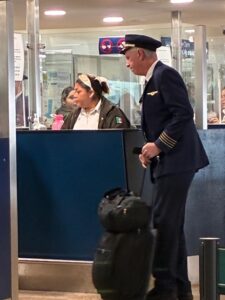
This case reinforces several key principles in Virginia workers’ compensation law. Firstly, employer-controlled parking lots and required shuttle routes can fall within the scope of employment. Second, being “clocked in” is not the standard, and coverage may apply when an employee is performing a necessary activity directly connected to employment, even before a shift officially begins. Finally, employer-mandated conditions matter, and when an employer requires specific uniforms, parking locations, or transportation routes, risks arising from those requirements may be compensable.
Because every injury scenario is different, our Workers’ Compensation Team at Abrams Landau helps individuals understand their rights and navigate claims from start to finish. If you or someone you love has been injured while on the job or due to an airport-related accident, don’t wait. Lawyer Doug Landau and the team at ABRAMS LANDAU, Ltd. are committed to advocating for injured workers and their families. Contact us today to get experienced legal help tailored to aviation-related injuries at frontdesk@landaulawshop.com or call/text us at (703) 796-9555.