
If I am injured in a Car Crash, Can the other Driver Just Pay My Bills?
Paying medical bills and other costs after a car crash is one of the top concerns of injured victims as they try to recuperate and get back to work.
Experienced injury lawyer Doug Landau has regularly counseled clients as to how to move forward after a bike crash, car accident, dog attack, and other disabling events. Recently, Landau was asked if the defendant couldn’t just pay the plaintiff’s bills.
Landau notes, “That would be wonderful, but unlikely.
First of all, in cases where the defendant has not been convicted in Traffic Court or General District Court, and where there are not even charges, pending, the defendants insurance company would not allow them to do so. Likewise, insurance defense counsel, or even personally retained counsel, for the defendant would advise their clients that paying any Medical or other bills of the plaintiff. That could be seen as an admission of guilt. Especially in cases where there are no chargesp ending, or Traffic Court has not yet occurred, that would not be a smart move by the defense.
Secondly, insurance companies generally advise their insured not to have any interactions with the injured plaintiff, for fear of them saying something that might be used against them in court. Insurance companies always try to get an early taped statement from the injured victim, in order to develop facts that they can use against the plaintiff and their case later. They don’t want their insured making the same mistake.
Next, a defendant has car insurance, homeowners insurance, umbrella, excess, and other coverages precisely to pay for the harms and loss as they caused by their unsafe conduct. Their obligation under their insurance contract is to:
-
While the law seeks to protect victims injured through no fault of their own, the laws of the Commonwealth of Virginia do not require a Defendant driver to pay the medical bills of another motorist, cyclist or pedestrian before Traffic Court and the Civil Court system have run their course.
pay premiums, and
- cooperate with the defense of the case.
- In exchange, the insurance company is to
- provide them with defense council, and
- pay a verdict up to the limits of the coverage that they have paid for with their premiums.
There are instances where Doug Landau has successfully gone to court to get a defendant to pay money outside of his insurance coverages. In one case, in criminal court proceedings, the General District Court judge ordered the defendant to pay restitution directly to the plaintiff, in lieu of court costs and a fine. This money would be in addition to whatever lawyer Landau won later at trial or received in compromise settlement of the case. This has happened in a few instances, but is rather uncommon. Very few lawyers ever suggest restitution to their clients when they go off to their Traffic Court or General, District Court, and other criminal type proceedings, prior to the personal injury case. In a publicized case where a teenager died after his junior year of high school at Lake Anna, the entirety of the several hundreds of thousands of dollars recovered in settlement, was paid by the defendants’ personally, as there was no insurance coverage for this loss. However, these types of results are very rare. In another case, where the defendant was stoned, lost, and injured several other motorists, in addition to the full policy limits, the plaintiff was able to get a $10,000 personal cash contribution by the defendant’s employer, who had not checked the driver’s terrible Department of Motor Vehicles record before putting him behind the wheel.
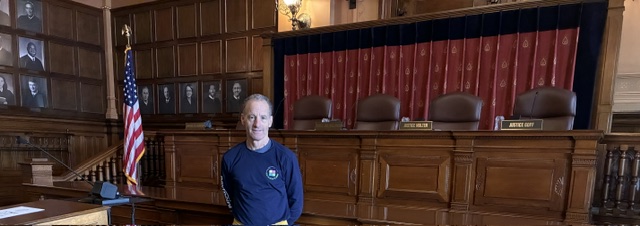
Multistate injury lawyer Doug Landau, shown here during a visit this week to the Indian Supreme Court in Indianapolis, has clients who have received restitution for small sums in court prior to the settlements of their personal injury cases. Such relief is rare, and usually where the injured victim does not have: health insurance, Short or Long Term Disability coverage; MedPay, PIP. Workers Compensation, Social Security or Medical Payments coverages
Landau also represented a woman who worked for one of the Court of Appeals judges who was badly injured. In that case, the insurance company prepaid some money, because: liability was absolutely clear; the defendant played guilty to causing the injuries; and, the insurance company was able to take a credit as against later settlement for those funds. In that case, the plaintiff had no: health insurance, long, or short-term disability coverage, MedPay, PIP, Medical Payments, or any other means by which to pay for Medical Care.
In a number of cases, the ABRAMS LANDAU injury team is able to get the doctors, hospitals and other healthcare providers to forbear from collection efforts until such time is the case is concluded, with the promise that they get paid out of settlement proceeds and/or verdict. This has worked exceptionally well over the last 4+ decades of Doug Landau has been trying major injury cases for innocent victims in Virginia and throughout the East Coast.
Bottom line, expecting the defendant to pony up money to pay medical bills or other obligations after a crash injury is unrealistic. Not only will the insurance company suggest they not do so, but their own personal counsel and Insurance defense counsel (with whom the insured MUST cooperate or void coverage!) assigned to the case will both join in advising them not to do so. While payments from personal assets have in fact been achieved by the ABRAMS LANDAU injury, law team, it is normally towards the back in the case, not during the acute phase, or even during convalescence.In a number of cases, the minimally insured Defendant driver has little to no assets to collect a verdict from after trial.
In a reported case Doug Landau won a jury verdict of $182,000, well in excess of the $100,000 in insurance coverage in the Alexandria Circuit Court. Thus, was only able to collect the $100,000 policy limits from the insurance company, plus pre- judgement interest and costs of $20,885.95. However, his client was not able to collect the remaining $82,000. SHe has a judgment against the impecunious defendant, which is good for 10 years. Lawyer Landau’s client can renew the judgment every 10 years, so that if the Defendant wins the lottery, inherits the family farm or marries into money, she may be able to collect the remainng $82,000 of her hard fought verdict, plus a LOT of post-judgment interest!
If you, someone you know and care about has been injured or disabled as a result of a crash and there are questions as to what laws apply, email or call us at ABRAMS LANDAU, Ltd. (703-796-9555).